It’s 11 PM, and you’re still charting. Again.
Sarah, a recent grad, refreshes her EMR dashboard one more time. Her attending saw 32 patients today. She only managed 24. The gap feels like failure. Never mind that she spent 20 minutes with a tearful patient whose diabetes is spiraling because she can’t afford her medications. Never mind that she caught a subtle medication interaction that could have sent someone to the ED. The number is what matters. And her number is lower.
She opens Instagram while eating cold leftovers at her kitchen table. A former classmate just posted about their promotion. Another colleague shared their acceptance into a fellowship program. Sarah closes the app, but the comparison has already done its work. The voice in her head is relentless: You’re falling behind. You’re not productive enough. If you were really cut out for this, it wouldn’t feel so hard.
This is what burnout looks like before it becomes burnout. This is the invisible curriculum at work.
The Hidden Model That Drives Healthcare Culture
Here’s what nobody tells you in training: healthcare operates on a self-esteem model. Your worth is tied to your performance. Metrics measure your value. Your success is determined by how you stack up against your peers.
Self-esteem asks one fundamental question: “How good am I?”
To answer it, you need external validation. You need to be better than others. You need to achieve, perform, and prove your worth through measurable accomplishments. Self-esteem is contingent, fragile, and exhausting to maintain because it requires constant evidence of success.
The problem? Healthcare is specifically designed to make this impossible.
You can’t be perfect in a system where perfect doesn’t exist. You can’t always perform flawlessly when you’re treating complex humans in a broken structure. You can’t win the comparison game when the metrics are rigged, and the goalposts keep moving.
But we keep trying. And it’s killing us.
The Three Pillars of the Invisible Curriculum
Perfectionism: The Standard That Guarantees Failure
From day one of clinical training, the message is clear: mistakes can kill people, so you cannot make mistakes. This isn’t wrong, exactly. Clinical excellence matters. Attention to detail saves lives.
But somewhere in the translation, “strive for excellence” became “anything less than perfect is failure.” We learned to catastrophize every error, to replay missed diagnoses on an endless loop, to beat ourselves up for being human.
Research shows that medical trainees exhibit significantly higher rates of perfectionism than the general population. But here’s the kicker: perfectionism is directly linked to burnout, anxiety, and depression. The very trait we cultivate in training is the one that breaks us in practice.
Perfectionism operates on the logic of self-esteem. If I’m perfect, I’m worthy. If I make mistakes, I’m not. Your worth becomes contingent on flawless performance in a field where flawless performance is literally impossible.
Comparison: The Game Nobody Wins
Sarah’s story isn’t unique. Every young clinician I work with describes the same exhausting mental calculus. How many patients did I see compared to my colleagues? How many procedures have I done? Who got published? Who got promoted? Who has it all figured out?
Social comparison is baked into medical culture from the very beginning. Class rank. Scores. Competitive job markets. Who gets the best job. The entire system trains you to measure your worth by how you stack up against others.
But research on self-esteem reveals a crucial truth: self-esteem is inherently comparative. You feel good about yourself when you’re doing better than others, and you feel terrible when you’re not. This means your sense of worth is constantly at the mercy of external circumstances you can’t control.
The result? A profession full of high achievers who never feel like they’re achieving enough.
RVUs: When Your Worth Has a Dollar Amount
Then there are the productivity metrics. RVUs. Patient volume. Throughput. Efficiency scores. Click rates. Time per encounter.
These metrics aren’t just measuring your work. They’re measuring you. They become proxies for your value to the organization, your worth as a provider, and your success as a clinician.
I’ve watched young clinicians( and a few seasoned ones) internalize these numbers in devastating ways. If your RVUs are low, you’re not pulling your weight. If you’re not seeing enough patients, you’re inefficient. If you spend too much time with complex cases, you’re hurting the bottom line. It becomes even more relevant when these metrics determine your income or bonus, when patients become numbers.
This is the ultimate expression of the self-esteem model: your worth is literally quantified and compared to your peers on a monthly dashboard.
The research on this is sobering. Studies show that productivity pressure is one of the strongest predictors of clinician burnout. When clinicians feel pressured to see more patients in less time, their sense of autonomy plummets, their moral distress increases, and their risk of burnout skyrockets.
The Psychological Trap We’re All In
Here’s what makes this so insidious: the self-esteem model isn’t totally wrong. External achievement does feel good. Positive feedback does boost your mood. Doing well compared to others does provide a temporary sense of worth.
The problem is that these feelings don’t last. Self-esteem is inherently unstable because it depends on circumstances that constantly change. You can feel great about yourself after getting positive feedback from a patient, then feel worthless an hour later when someone complains, or you miss something, or your productivity numbers come up short.
Research by Kristin Neff and others has demonstrated that self-esteem is actually a poor predictor of psychological well-being. People with high self-esteem often struggle with anxiety because they’re constantly worried about maintaining their status. They’re more likely to become defensive when criticized. They’re more vulnerable to depression when things don’t go their way.
And in a field where things frequently don’t go your way, where criticism is constant, and where maintaining status is impossible, self-esteem becomes a trap.
Why This Makes Healthcare Worse
The invisible curriculum doesn’t just harm clinicians. It harms patients, too.
When you’re operating from a self-esteem model, you become defensive about mistakes because they threaten your sense of worth. This makes it harder to acknowledge errors, learn from them, and implement system changes that would prevent future harm.
When you’re constantly comparing yourself to others, you’re less likely to ask for help when you need it. Asking for help feels like admitting you’re not as good as your peers. So you suffer in silence, and patients suffer the consequences of your isolation.
When productivity metrics drive you, you can’t provide the kind of care you were trained to give. You rush. You cut corners. You treat symptoms instead of people. And you watch your sense of meaning slowly erode.
Dr. Vaneet Sandhu’s work on compassion fatigue reveals a crucial insight. When clinicians fear showing compassion to themselves, they’re more likely to burn out and less able to show compassion to their patients. The invisible curriculum doesn’t just break us. It breaks our capacity to care for others.
The Framework We Were Never Taught
The cruel irony is that we were trained in self-criticism because being critical is essential to medicine. We need to question our clinical reasoning. We need to identify what’s wrong and fix it. We need diagnostic precision and attention to detail.
But we were never taught to turn that critical lens off. We were never taught that the same self-critical voice that helps you analyze a differential diagnosis will destroy you if you point it at your own worth as a human being.
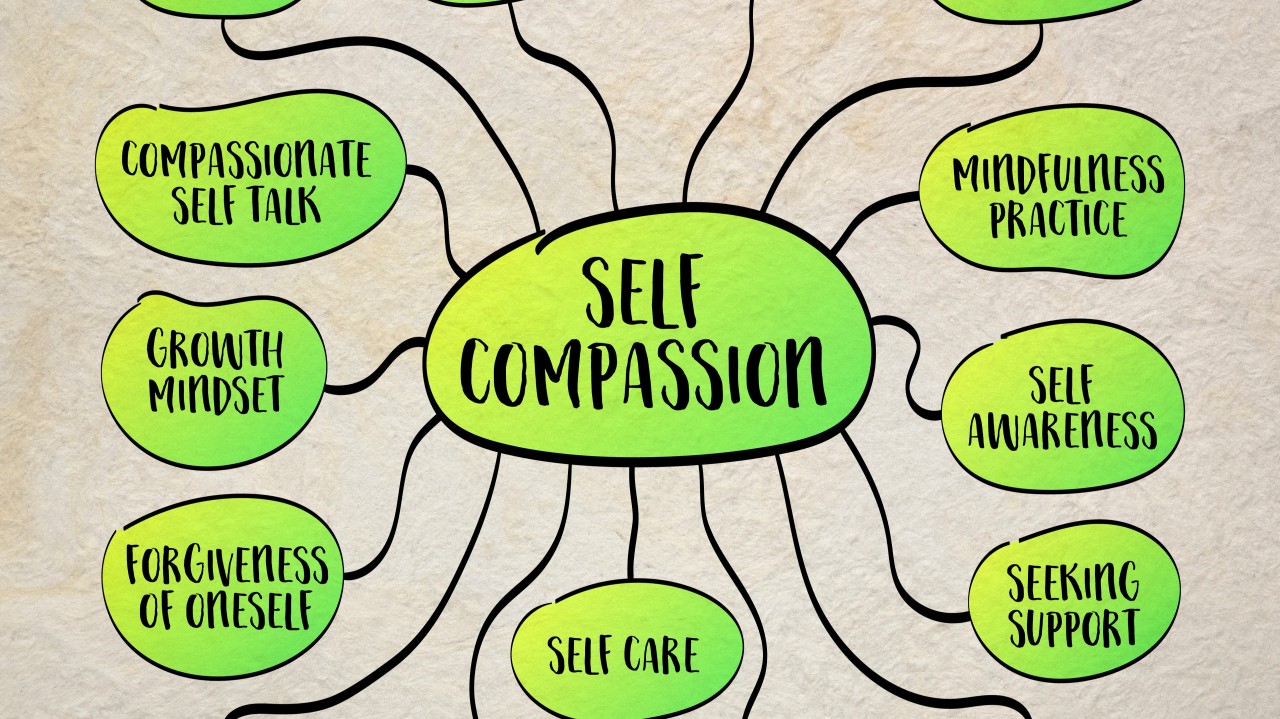
We were taught self-esteem when we needed self-compassion. We were taught to prove our worth by accepting our inherent humanity. We were taught to compare and compete when we needed to connect and support each other.
And now we’re paying the price.
What Comes Next
The research is unequivocal: the self-esteem model that drives healthcare culture is directly contributing to the burnout crisis. Perfectionism, comparison, and productivity pressure aren’t just stressful; they’re harmful. They’re psychologically toxic when they become the foundation of your sense of worth.
But here’s what gives me hope: burnout isn’t inevitable. It’s not a personal failing or a sign of weakness. It’s the predictable outcome of being trained in the wrong psychological model and then being asked to work in a system designed to make that model fail.
There’s a better way. A way that protects against burnout rather than causes it. A way that builds resilience without requiring you to be perfect. A way that values your humanity instead of just your productivity.